How to Break Free From the Pain of Your Past

Most of us have quite a trail of heart-wrenching moments, hardship, rough spots, downright painful experiences in our wake. Inviting Christ has our Lord and Savior does not erase our past. His blood covers our sins and we are forgiven, but the chains of our lives before Him usually tie us until we do something about it.

We carry our (emotional) baggage (our wounds, our guilt, our pain) around and doing so slows down our walk with Christ.

So can we leave behind the unnecessary baggage we haul around? YES

How?

Confess out loud what happened to you.

This is about voicing the truth. You cannot get rid of something you don’t know you have or something you deny. You need to face the truth and say it aloud. Words have power and hearing yourself speaking the truth of your past is like standing up to your enemy

You have been abused? Say it.

You have been cursed, mistreated, belittled, ignored, neglected, and/or degraded? Say it.

Confess out loud where the blame belongs

You are not to blame for what they did to you. You did not ask or beg for it, you did not deserve to suffer contrarily to what they want you to believe.

Lay the responsibility of each party where it belongs:

  • They are responsible for what they did to you. Hurting you has been their choice. Their behaviors, their hatred,  the injustice you suffered at their hands belong to them.
  • You are responsible for believing their lies, for letting it linger long enough to damage you. The lies you believe (you are not enough, you are good for nothing, you are stupid, you are worthless, you deserved it, you are faulty, you are evil, etc.) come between God and you and there is no room for lies in your relationship with God.

Confess the truth of who you are in Christ.

You are God Almighty’s beloved child. You are precious. You are chosen; He chose you. You are holy. You are made in his image and his Spirit is in you. He made you the way He wanted you for His plan. He loves you, He wants to give you the best and He wants you to receive it as the gift it is … something for good, something for his glory, something perfect in design.

God is love. There is no darkness in God; He is all light and all love and all truth: 100%.

Pray  God:

  • for the forgiveness of your sins. You have hauled around your pain perhaps because you have known nothing else, because suffering is familiar, because you believed “them” rather than God. Choosing anything else but God is a sin in His eyes. Ask him to forgive you.
    [God’s compassion is great, He wants you in a right standing with Him and the way to do it is to repent and ask for His forgiveness.]
  • for his help to forgive those who hurt you and for the forgiveness of their sins. Bless them. By refusing to forgive them, you only tighten the chains of your suffering. God commanded you to love your enemy. Forgiving them releases the hold they have on you and the hold your pain has on your life.
  • so He sets  you free from the chains you are in,  be it your pain, the lies, the curses, the soul ties or anything else.

When you stand in the truth in front of God, when you choose to trust His words to you and to obey Him (behave according to His will), miracles happen.

Be Imitators of Christ

What does it possibly mean? What does “walking in love” entail?

Which part of ‘be imitators of Christ’ relates to destroying the sinner? Why are we, human beings, tempted to take upon ourselves to get justice? Why are we comfortable with being judge, jury, and executioner?

Sinners

I do not recall Jesus ever rejecting a sinner. I do not recall Jesus debasing the Samaritan woman at the well, I do not recall Jesus punishing the adulteress who would have been stoned to death if he had not told the people ‘let he who is without sin cast the first stone’, and I do not recall the thief – a criminal and sinner according to the laws and the Law – who was crucified beside him being told off and rejected when he asked Jesus to remember him. He did not send away the centurion – surely he had killed people – who went to him to ask him to heal his servant.

Jesus did not seek to destroy the woman even though she had sinned; Jesus did not show disgust toward the thief, and Jesus did not display contempt toward the centurion. He showed compassion to the woman, he welcomed the thief, and he healed the servant because of the centurion’s faith.

Does this means Jesus chose to love these people if he forgave them on the spot and treated them well?

Jesus gave his life to reconcile the sinner with his Father, would he render his sacrifice null and void by punishing those who seek him and the Father?

God is love, he so loved the world he sent his own son to die so we could have a relationship with him… God never destroys those who seek him, God blesses them.

Advice on Behaviors

 22Flee also youthful lusts: but follow righteousness, faith, charity, peace, with them that call on the Lord out of a pure heart. 23But foolish and unlearned questions avoid, knowing that they do gender strifes. 24And the servant of the Lord must not strive; but be gentle unto all men, apt to teach, patient, 25In meekness instructing those that oppose themselves; if God peradventure will give them repentance to the acknowledging of the truth; 26And that they may recover themselves out of the snare of the devil, who are taken captive by him at his will.
2 Timothy 2:22-26 (KJV)

I think reading what the amplified Bible says is worth it.

22 Run away from youthful lusts—pursue righteousness, faith, love, and peace with those [believers] who call on the Lord out of a pure heart. 23 But have nothing to do with foolish and ignorant speculations [useless disputes over unedifying, stupid controversies], since you know that they produce strife and give birth to quarrels. 24 The servant of the Lord must not participate in quarrels, but must be kind to everyone [even-tempered, preserving peace, and he must be], skilled in teaching, patient and tolerant when wronged. 25 He must correct those who are in opposition with courtesy and gentleness in the hope that God may grant that they will repent and be led to the knowledge of the truth [accurately understanding and welcoming it], 26 and that they may come to their senses and escape from the trap of the devil, having been held captive by him to do his will.
2 Timothy 2:22-26 (AMP)

Beating righteousness into people is not being an imitator of Christ. Love does not coerce, love does not destroy, love from God does not debase. The Holy Spirit convicts, man doesn’t; God knows all, no man on Earth does.

8 Finally, be ye all of one mind, having compassion one of another, love as brethren, be pitiful, be courteous: 9 Not rendering evil for evil, or railing for railing: but contrariwise blessing; knowing that ye are thereunto called, that ye should inherit a blessing. 10 For he that will love life, and see good days, let him refrain his tongue from evil, and his lips that they speak no guile: 11 Let him eschew evil, and do good; let him seek peace, and ensue it. 12 For the eyes of the Lord are over the righteous, and his ears are open unto their prayers: but the face of the Lord is against them that do evil. 13 And who is he that will harm you, if ye be followers of that which is good?

1 Peter 3:8-13 (KJV)

And last but not least…

23 who, when He was reviled, did not revile in return; when He suffered, He did not threaten, but committed Himself to Him who judges righteously;

1 Peter 2:23 (NKJV)

Let God take care of those who have hurt or wronged you, let God show you justice, and let God judge righteously. He knows everything, no man on Earth does.

In a nutshell, be loving, compassionate, forgiving, and kind. Keep your mouth shut when someone hurts you or wrongs you… Jesus did. Forgive, Jesus did it too.

34 Then Jesus said, “Father, forgive them, for they do not know what they do.” And they divided His garments and cast lots.”

Luke 23:34 (NKJV)

Would he have asked God to forgive them if he had not done it himself first?

Jesus would not have been God’s son if he had only forgiven those who actually hurt him and made the rest of mankind pay for the pain he felt. God’s love is not partial, it is whole. Vengeance and justice belong to God, no one else. Partial forgiveness is not forgiveness, it is misplaced anger… but that’s a topic for another blog post.

Cross Bearing

Being a good imitator of Christ is not always painless. As he was hated, criticized, met with opposition, ridiculed, and mistreated, so will we.

14 But and if ye suffer for righteousness’ sake, happy are ye: and be not afraid of their terror, neither be troubled; 15 But sanctify the Lord God in your hearts: and be ready always to give an answer to every man that asketh you a reason of the hope that is in you with meekness and fear: 16 Having a good conscience; that, whereas they speak evil of you, as of evildoers, they may be ashamed that falsely accuse your good conversation in Christ. 17 For it is better, if the will of God be so, that ye suffer for well doing, than for evil doing.

18 For Christ also hath once suffered for sins, the just for the unjust, that he might bring us to God, being put to death in the flesh, but quickened by the Spirit: 19 By which also he went and preached unto the spirits in prison; 20 Which sometime were disobedient, when once the longsuffering of God waited in the days of Noah, while the ark was a preparing, wherein few, that is, eight souls were saved by water.

1 Peter 3:14-2

It takes God’s grace to be an imitator of Christ. Without his grace, human nature gets in the way, our ego gets in the way, anger, violence, and wickedness get in the way.

It takes yielding to the Holy Spirit to be an imitator of Christ.

Character of the New Man

12 Therefore, as the elect of God, holy and beloved, put on tender mercies, kindness, humility, meekness, longsuffering; 13 bearing with one another, and forgiving one another, if anyone has a complaint against another; even as Christ forgave you, so you also must do. 14 But above all these things put on love, which is the bond of perfection. 15 And let the peace of God rule in your hearts, to which also you were called in one body; and be thankful. 16 Let the word of Christ dwell in you richly in all wisdom, teaching and admonishing one another in psalms and hymns and spiritual songs, singing with grace in your hearts to the Lord. 17 And whatever you do in word or deed, do all in the name of the Lord Jesus, giving thanks to God the Father through Him.

Colossians 3:12-17 (NKJV)

Love is not judgmental, love does not discriminate, love does not accuse. Love is merciful, love is inclusive, love forgives.

A Friend Loves Always

One of the most striking stories of friendship between human beings in the Old Testament is that of Jonathan and David. In today’s terms, they were the first “bromance” in history.

1And it came to pass, when he had made an end of speaking unto Saul, that the soul of Jonathan was knit with the soul of David, and Jonathan loved him as his own soul.

1 Samuel 18:1 (KJV)

These following verses are the same verse, but from different versions:

New International Version
After David had finished talking with Saul, Jonathan became one in spirit with David, and he loved him as himself.

New Living Translation
After David had finished talking with Saul, he met Jonathan, the king’s son. There was an immediate bond between them, for Jonathan loved David.

English Standard Version
As soon as he had finished speaking to Saul, the soul of Jonathan was knit to the soul of David, and Jonathan loved him as his own soul.

Shortly put, Jonathan was King Saul’s son and King Saul hated David enough to “hunt him”, to seek ways and to attempt to get rid of him. As you might have guessed, David survived every King Saul’s attempts to kill him.

In the New Testament, however, it is a surprising relationship you will find in a letter from Paul to Philemon. You know, this letter everyone keeps skipping because they think the letters to the Corinthians, the Galatians, the Romans, the Ephesians, and the Colossians convey more crucial content than it. Paul’s letter to Philemon seems out of place among the other letters. First, the letter is addressed to one person instead of a group and second, Paul asked for a favour instead of teaching, scolding, or directly exhorting the addressee. The tone is intimate (read this word to mean that they know and understand each other), full of respect and consideration.

But without thy mind would I do nothing; that thy benefit should not be as it were of necessity, but willingly.

Philemon 1:14 (KJV)

New International Version
But I did not want to do anything without your consent, so that any favor you do would not seem forced but would be voluntary.

New Living Translation
But I didn’t want to do anything without your consent. I wanted you to help because you were willing, not because you were forced.

English Standard Version
but I preferred to do nothing without your consent in order that your goodness might not be by compulsion but of your own accord.

Why did Paul ask something of Philemon instead of commanding him to do it? Paul did not lack in authority; he pointed it out to Philemon and highlighted the fact he deliberately chose not to use it. Most of the people he wrote to were people who converted during his visits to these regions. Most considered him their “spiritual father”, their mentor, their teacher. However, in the name of friendship, Paul asks Philemon to do something instead of commanding him to do so.  Why did Paul choose it?

I read some commentaries about this letter and most agree on the fact that Paul provided Philemon with an opportunity to do one more thing for the Lord, a gesture done willingly.

2 Corinthians 9:7
Each one should give what he has decided in his heart to give, not out of regret or compulsion. For God loves a cheerful giver.

1 Peter 5:2
Be shepherds of God’s flock that is among you, watching over them not out of compulsion, but because it is God’s will; not out of greed, but out of eagerness;

But what if there was more to it?

From the beginning of the letter, we know Paul is confident in Philemon’s answer. Philemon is a man who loves the Lord and God’s followers. From the way Paul addresses Philemon in the beginning of his letter, I keep picturing him as the eager type: eager to please the Lord, fervent in his walk of love,  and ready to walk in obedience.

What if Paul gave Philemon an opportunity to grow? The letter mentioned an unpleasant history between Philemon and Onesimus; Paul must have suspected that the favour he asked of him would be a tall order and a sore spot in Philemon’s life. In order for Philemon to give Paul a positive answer, he had to make things right with God in regards to Onesimus and within himself over the past, and most likely forgive Onesimus. A positive answer to Paul required of Philemon to choose God, to choose to grow in maturity, and Paul knew it.

Since no one can coerce someone else into growing up; it had to be done willingly.

Iron sharpeneth iron; so a man sharpeneth the countenance of his friend.

Proverbs 27:17

New International Version
As iron sharpens iron, so one person sharpens another.

New Living Translation
As iron sharpens iron, so a friend sharpens a friend.

English Standard Version
Iron sharpens iron, and one man sharpens another.

In my own opinion, the most potent verse about friendship is found in Proverbs:

A friend loveth at all times, and a brother is born for adversity.

Proverbs 17:17 (KJV)

A friend loves at all times, and to know what love is and what it does, go to 1 Corinthians 13:4-7.

Love suffers long and is kind; love does not envy; love does not parade itself, is not puffed up; does not behave rudely, does not seek its own, is not provoked, thinks no evil; does not rejoice in iniquity, but rejoices in the truth; bears all things, believes all things, hopes all things, endures all things.

1 Corinthians 13:4-7 (NKJV)

People usually enter a friendship because they like and love their friend from the get-go. If you are in a friendship that does not engage your heart in a positive way, it is not a friendship and you are not a friend. Most agree that friendship happens between like-minded people, but it is not always the case; something common brings them together but they might very well be opposites in terms personality and outlook on life.

Friendship, in God’s eyes, serves a purpose. Friendship is a relationship in which the friends are called to serve (to minister to) one another, to be there for each other. Friendship is also a type of relationship that heightens awareness.  We come to be (to exist, to label who we are) only in front of someone else. Difference in opinions, shortcomings, and subconscious and conscious emotions find an outlet through friendship and sometimes also get in the way. Friendship is never about self, it is always about the other person because love is selfless (love does not seek its own and love does not parade itself, is not puffed up).

Real friends are honest with each other, they are truthful, and they care about one another. A friend provides help and support and meets the needs he can meet. Friendship overall builds up the two people in it. Friendship is benevolent because love is kind and love thinks no evil. Friendship is one of God’s ways to show us his love, because a friend loves at all times and love forgives all.

Need a reminder on what love is and what love does?

Love cannot exist without free will. Love does not behave rudely, therefore love does not allow coercion, domination, and tyranny and coercing Philemon in any way would have been proof that Paul did not love him. Paul loved Philemon as a friend, hence the reason he granted him the opportunity to exert his free will, the opportunity to grow in God and in love, and thus become a more mature Christian. That’s what friends do for one another; they help each other grow closer to God by loving their friend unconditionally, by loving the way God loves, by God loving their friend through them.

Related articles:

Top 7 bible verses about friendship

Being a Friend

Bible verses about friendship: 20 good scripture quotes

True Friendship

God’s Wrath: The Price of Repeated Disobedience

The Israelites have done just about everything to test God’s infinite patience and love and they have often found themselves oppressed, diminished, and enslaved because they would not be humble before God. They were punished for their misconduct. When they were brought to their knees because of their punishment, they would cry out to God and He would rescue them, always reiterating what He wants:

And call upon me in the day of trouble: I will deliver thee, and thou shalt glorify me.
Ps 50:15  (KJV)

However, they had a short memory span and probably did not fully understand the meaning of “glorifying God”. They ended up displeasing God all over again and finding themselves in the same (or in worse) circumstances than those they were rescued from.

There are six things that the Lord hates, seven that are an abomination to him: haughty eyes, a lying tongue, and hands that shed innocent blood, a heart that devises wicked plans, feet that make haste to run to evil, a false witness who breathes out lies, and one who sows discord among brothers.

Proverbs 6:16-19 (KJV)

Since God does not change, He still hates these things, even in people who know the Word of God.

16 But unto the wicked God saith, What hast thou to do to declare my statutes, or that thou shouldest take my covenant in thy mouth?
17 Seeing thou hatest instruction, and castest my words behind thee.
18 When thou sawest a thief, then thou consentedst with him, and hast been partaker with adulterers.
19 Thou givest thy mouth to evil, and thy tongue frameth deceit.
20 Thou sittest and speakest against thy brother; thou slanderest thine own mother’s son.
21 These things hast thou done, and I kept silence; thou thoughtest that I was altogether such an one as thyself: but I will reprove thee, and set them in order before thine eyes.

Ps 50:16-21 (KJV)

This sounds like the introduction to a lesson learned the hard way. God’s wrath hurts (Lamentations 2). Consider what happened to Adam and Eve for disobeying and see where it led mankind. Remember why Noah built an ark so a handful of righteous men would survive the flood while the rest of humanity was set to perish? Why was there a flood in the first place?

He does not only turn his wrath to the unbelievers, but also against those who are supposed to know him and those He chose.

5 Therefore have I hewed them by the prophets; I have slain them by the words of my mouth: and thy judgments are as the light that goeth forth.
6 For I desired mercy, and not sacrifice; and the knowledge of God more than burnt offerings.
7 But they like men have transgressed the covenant: there have they dealt treacherously against me.

Hosea 6:5-7 (KJV)

God still teaches lessons to his children when they deserve it.

15 The rod and reproof give wisdom: but a child left to himself bringeth his mother to shame.

Proverbs 29:15 (KJV)

God is  also just and loving.

 20 The soul that sins, it shall die. The son shall not bear the iniquity of the father, neither shall the father bear the iniquity of the son: the righteousness of the righteous shall be upon him, and the wickedness of the wicked shall be upon him.
21 But if the wicked will turn from all his sins that he has committed, and keep all my statutes, and do that which is lawful and right, he shall surely live, he shall not die.
22 All his transgressions that he has committed, they shall not be remembered against him: in his righteousness that he has done he shall live.
23 Have I any pleasure at all that the wicked should die? says the Lord GOD: and not that he should turn from his ways, and live?
24 But when the righteous turns away from his righteousness, and commits iniquity, and does according to all the abominations that the wicked man does, shall he live? All his righteousness that he has done shall not be remembered: in his trespass that he has trespassed, and in his sin that he has sinned, in them shall he die.
25 Yet you say, The way of the Lord is not equal. Hear now, O house of Israel; Is not my way equal? are not your ways unequal?
26 When a righteous man turns away from his righteousness, and commits iniquity, and dies in them; for his iniquity that he has done shall he die.
27 Again, when the wicked man turns away from his wickedness that he has committed, and does that which is lawful and right, he shall save his soul alive.
28 Because he considers, and turns away from all his transgressions that he has committed, he shall surely live, he shall not die.
29 Yet says the house of Israel, The way of the Lord is not equal. O house of Israel, are not my ways equal? are not your ways unequal?
30 Therefore I will judge you, O house of Israel, every one according to his ways, says the Lord GOD. Repent, and turn yourselves from all your transgressions; so iniquity shall not be your ruin.
31 Cast away from you all your transgressions, by which you have transgressed; and make you a new heart and a new spirit: for why will you die, O house of Israel?
32 For I have no pleasure in the death of him that dies, says the Lord GOD: therefore turn yourselves, and live.

Ezekiel 18:20-32 (KJV)

Just remember this:

10 For a day in thy courts is better than a thousand. I had rather be a doorkeeper in the house of my God, than to dwell in the tents of wickedness.

Psalms 84:10 (KJV)

Related:

5 Truths about the Wrath of God

Bible Verses About the Wrath of God

Violence

The Bible Often Mentions God’s Wrath. Why does it matter?

Preserve Your Relationship With God

I think the verses speak for themselves.

Avoid what keeps you away from Him and part of that means that a Christian must not instigate or engage in these things. Behaving this way costs you your relationship with God; this is not His way.

We are called to be imitators of Christ, to be peace makers, to love one another (friends, foes, and everyone in-between). Being Christian is not about getting one’s points across, about being right (and everybody else’s wrong), or about “who’s best”. It is about following Christ, walking in his footsteps, and serving God – as he did.

Preserve your relationship with God at all cost. Let nothing and no one stand in the way of Him and you.

To Those Who Suffer

Nobody knows suffering as much as Jesus does. He endured it all (emotional, psychological, and physical). He was sought after everywhere he went, either by crowds drawn to him or by Pharisees and the likes who wanted to discredit him and ultimately get rid of him. He had a few friends, followers, yet his people rejected him as a prophet, as the Son of God.

3 He is despised and rejected of men; a man of sorrows, and acquainted with grief: and we hid as it were our faces from him; he was despised, and we esteemed him not.

4 Surely he hath borne our griefs, and carried our sorrows: yet we did esteem him stricken, smitten of God, and afflicted.

5 But he was wounded for our transgressions, he was bruised for our iniquities: the chastisement of our peace was upon him; and with his stripes we are healed.

ISAIAH CHAPTER 53 KJV

Jesus, being everything God loves, was nothing to men, insignificant, disregarded. The only men who saw him for who he really was were those who were chosen by God. Jesus was a man of sorrows, familiar with grief; he knew sadness inside out.

Is our walk with God very different from that of Jesus?

Jesus is holy and sanctification is every Christian’s calling. Can we be saints and live a very different life from that of Jesus? That would be very illogical.

Just as it happened with Jesus, nobody will recognize God in us unless God wants them to see Him. The truth we tell will be perceived as lies, our kindness will be perceived as weakness, and our guileless intents will be perceived as wicked. The light of God shines through us, but can a blind man see the light? We are all blind without the Spirit of Truth.

The suffering in our lives has a purpose. It brings us to God, on our knees. Many go to Him for relief and find it. Suffering and understanding give us compassion for others. When we walk in obedience to God, He will protect us from pain because His presence is more powerful than man-inflicted pain. His love is so overwhelming it will be the only thing we feel.

Our perceptions and understanding change in God’s presence; His love is revealed to us and through us, and prior suffering fades away. Love heals, love gives life, and love stands in truth.

Paul says about suffering that if we take part in his suffering, we also take part in his consolation. I for one believe with all my heart that my own suffering is worth it if it opens a door to God revealing Himself to someone who needs Him.

I am just a vessel, but I find honour in Him using me to reveal His glory. There is nothing grander than to be in the presence of God Almighty. My consolation for suffering? Seeing the kingdom of God, his reign, feeling His love and presence, and contemplating His glory. This is enough to have me rejoice, to praise his name, to put a smile on my face and to be awed at God’s Almightiness.

An Approved Workman

14 Remind them of these things, commanding them before the Lord that they not argue about words, which leads to nothing of value and to the destruction of those who hear them. 15 Study to show yourself approved by God, a workman who need not be ashamed, rightly dividing the word of truth. 16 But avoid profane foolish babblings, for they will increase to more ungodliness, 17 and their word will spread like gangrene: Among them are Hymenaeus and Philetus, 18 who have erred concerning the truth, saying that the resurrection has already occurred, and who overthrow the faith of some. 19 But the firm foundation of God stands, having this seal, “The Lord knows those who are His,” and, “Let everyone who calls on the name of Christ depart from iniquity.”

20 In a large house there are not only gold and silver vessels, but also those of wood and clay; some are for honor, and some for dishonor.21 One who cleanses himself from these things will be a vessel for honor, sanctified, fit for the Master’s use, and prepared for every good work.

22 So flee youthful desires and pursue righteousness, faith, love, and peace, with those who call on the Lord out of a pure heart. 23 But avoid foolish and unlearned debates, knowing that they create strife. 24 The servant of the Lord must not quarrel, but must be gentle toward all people, able to teach, patient, 25 in gentleness instructing those in opposition. Perhaps God will grant them repentance to know the truth,26 and they may escape from the snare of the devil, after being captured by him to do his will.

2 Timothy 2:14-26


Strength

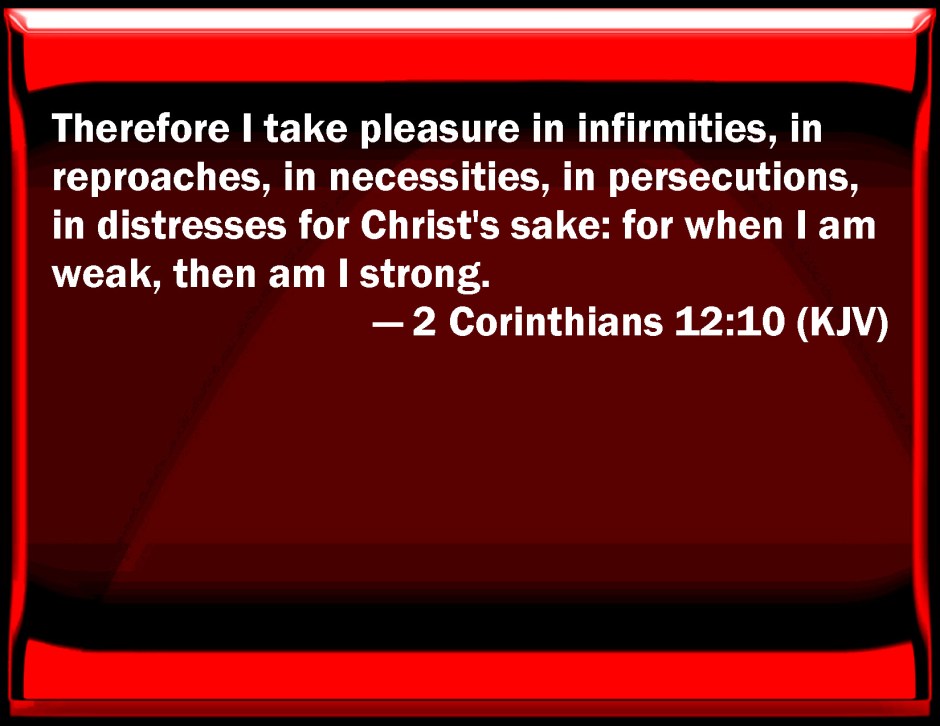
Why would Paul rejoice in his own weakness?

Finding a plausible explanation is not obvious, is it?

As I understand it, strength is not what we know as strength of personality. It is neither about bullying nor about demanding respect. Strength is not some snappy and hurtful comebacks. Neither is it playing the blame game nor telling home truths.

Strength is utter weakness in which He is strong.

Strength is being in tune with Almighty God.

Strength comes from and is the Holy Spirit; strength is love and forgiveness.

You are Almighty God’s perfect instrument. Your own weakness makes it so that the Holy Spirit can operate in you and use you to fulfill God’s will.

See?

And he said unto me, My grace is sufficient for thee: for my strength is made perfect in weakness. Most gladly therefore will I rather glory in my infirmities, that the power of Christ may rest upon me.

2 Corinthians 12:9 KJV

Think about it. Feeling Almighty God’s love go through you is as close to Him as you are going to get in this realm.

What a wonderful feeling!


Meekness and Love


From what little I understand about meekness, it is a mix of humbleness, of self-sacrifice, and love.

Jesus was meek, a servant to all, and yet our king. He was ridiculed, humiliated, and yet there were nobody greater than him to ever walk upon the face the Earth. Day after day, he was obedient to his Father, a father who was in him, and him in the Father. He spoke his Father’s words every time he opened his mouth, did his Father’s bidding, healed the sick, forgave sinners, taught his people about his Father. He loved his Father, and loved his people. Never did he lose patience with his disciples because they did not understand his words; never did he turn away someone willing to repent no matter what his or her sins were. Jesus loved God and God’s creation (of which we are), plain and simple.

Why are some people arrogant and contemptuous, and some others simply modest and loving? Are these traits innate or can they be learnt or developed? I would not know, but what I do know is that you can ask for the fruits of the Spirit.

7Ask, and it shall be given you; seek, and ye shall find; knock, and it shall be opened  unto you: 8For every one that asketh receiveth; and he that seeketh findeth; and to him that knocketh it shall be opened.

Matthew 7:7-8, KJV

Can we truly love without being meek? Can we obey God without being meek?
If God himself does not give us the capacity, we cannot love, and we cannot be meek, that much I am certain of. If we have the capacity to love someone (be he foe or friend) and if we possess a personality trait called meekness, it is God’s doing, not ours. If left to our own device, we are consumed with anger, pain, anxiety, arrogance, and a thirst for vengeance.

Whatever good we have in us comes from God.